
A Likert questionnaire sample is a ready-made example of survey questions that use a scaled response format, such as “strongly agree” to “strongly disagree,” to measure attitudes, opinions, or perceptions.
Many researchers, educators, and business teams use these samples as starting points when designing feedback forms or evaluation tools.
To give useful context, the main sections below walk through common Likert formats, example questions, and practical tips for adapting them.
Likert questionnaires are one of the most reliable ways to measure opinions, attitudes, and satisfaction — but clarity and consistency are key. FORMEPIC makes it easy to create professional Likert questionnaires in minutes with balanced scale options, clean layouts, and mobile-optimized design that encourages higher response rates. Create your Likert questionnaire with FORMEPIC and start collecting more accurate insights today. Try FORMEPIC for free

Key Takeaways
- Likert questionnaires offer an easy, standardized method of converting opinions and attitudes into numerical data that can be compared across groups, change over time, and guide evidence-based decisions. Selecting an appropriate scale length, such as the common 5-point or 7-point formats, strikes a good balance between ease of understanding for respondents and analytical precision.
- Well-written statements are the foundation of a robust Likert survey and have to be clear, neutral, and focused on a single idea. No double-barreled wording, leading phrases, or jargon! That just confuses people and makes your data more unreliable.
- This, along with your response format and overall scoring method frame how meaningful your results are. You can add up items, take averages, or simply categorize responses into positive, neutral, and negative sentiment bands. Designing balanced scales and planning how you will score and interpret results up front makes reporting and decision-making faster and more accurate.
- Likert questionnaires operate across many use cases including customer feedback, employee engagement, product research, and event evaluation. With specific question samples for each context, you can measure the right thing: satisfaction, communication, or feature usefulness, and translate responses into action.
- Psychological and methodological biases, such as central tendency, acquiescence, social desirability, and question order effects, can stealthily skew your results. You can mitigate these risks by interspersing positive and negative items, using anonymous surveys, pre-testing, and ensuring careful question order and wording.
- Solid analysis and visualization complete the picture, with descriptive statistics, sentiment grouping, and crisp charts communicating results in an accessible fashion. With a dose of good design, thoughtful scaling and transparent analysis, you can create Likert questionnaires that are easy for people to answer and powerful for you to interpret.
What is a Likert Questionnaire?
A Likert questionnaire is a survey tool that measures attitudes, beliefs, or perceptions using a consistent response scale known as the point likert scale. Each question is a Likert scale question: a statement that people rate on a quantitative scale, usually based on how much they agree or disagree. This bipolar scale captures movement between two poles, such as positive versus negative or satisfied versus dissatisfied, allowing for a nuanced understanding of customer experience surveys.
Researchers typically treat the responses as if they were an interval scale, enabling them to sum or average item scores. Typical formats include 5-point, 7-point, or 10-point scales, with a 5-point scale such as ‘Strongly disagree’ to ‘Strongly agree’ prioritizing clarity and speed. On the other hand, a 7-point scale offers more granularity for subtle opinions, while a 10-point scale introduces additional gradation that may lead to speculation among survey respondents.
These likert scale surveys are advantageous because they transform subjective evaluations into something that can be analyzed with descriptive statistics and, cautiously, with parametric or non-parametric tests, ensuring the effectiveness of survey design and the accuracy of survey responses.
1. The Core Concept
A Likert scale is a structured rating system used in questionnaires to capture the intensity and direction of an attitude. Each item requires survey respondents to judge a single statement on a specified dimension, most commonly agreement or disagreement, but also frequency, importance, or likelihood. For instance, ‘I feel confident using our new CRM system’ (strongly disagree to strongly agree) is a typical Likert scale question.
The usual structure is simple: a clear statement, followed by ordered response options that run from one pole to the opposite pole. This bipolar design lets you not only observe if people lean positive or negative but also how strongly they feel. A Likert scale survey will usually aggregate several related items into a scale score, such as a total satisfaction index or an average engagement score, if the items measure the same construct.
For decision-making, the power of Likert scale surveys is that they provide you with numbers to work with. You can segment it and compare segments, observe its movement over time, or check if segment differences are statistically significant. At the same time, these scales can be skewed by biases such as social desirability or acquiescence, where individuals want to please others or tend to agree with everything, respectively.
Well-designed Likert scale questions and careful interpretation help minimize these risks, but never eliminate them completely.
2. The Scale Points
|
Scale type |
Typical labels example |
Clarity for respondents |
Granularity of insight |
Common user preference |
|---|---|---|---|---|
|
5‑point |
Strongly disagree → Strongly agree |
Very high |
Moderate |
Very common |
|
7‑point |
Strongly disagree → Strongly agree (7 steps) |
High |
High |
Popular in research |
|
10‑point |
1 → 10 with anchors at ends |
Moderate |
Very high |
Mixed |
Most Likert questionnaires use standard scale points such as: “Strongly Disagree,” “Disagree,” “Neutral” (or “Neither agree nor disagree”), “Agree,” and “Strongly Agree.” These five are well-known internationally and fit most general audiences well. A 7-point version adds choices like “Slightly disagree” and “Slightly agree” for more nuance.
When deciding the number of points, begin with your research objective. If you want fast, low-commitment answers from a wide population, a 5-point scale is generally adequate. If you’re conducting a more granular academic or UX study, a 7-point scale can catch these smaller shifts without taxing most respondents.
Save a 10-point scale for when stakeholders already think in 0 to 10 terms, such as rating likelihood to recommend or performance scores. Balance is key. If you want to allow neutrality, then scales should have symmetrical positive and negative options around a clear midpoint.
Too many points can be overwhelming, particularly on mobile displays or with lower-literacy audiences. Not enough points can squash variation and obscure significant distinctions. The goal is a scale that seems natural but provides the granularity your analysis requires.
3. The Statement
Key characteristics of strong Likert items include:
- Clarity: one idea per statement, no jargon.
- Neutrality: avoid leading language or emotional framing.
- Relevance: each item should align tightly with your construct.
- Specificity: concrete behaviors or perceptions, not vague generalities.
- Balance: A mix of positively and negatively worded items when appropriate.
To write good items, begin by clearly identifying the attitude you want to measure — say ‘trust in company leadership’ or ‘perceived app usability.’ Write straightforward statements such as, “I have confidence in the leadership team’s ability to make good decisions,” instead of, “Leadership is visionary and inspiring.
Then, scan for double-barreled phrasing. For example, ‘The product is easy and affordable’ needs to be broken into two, one on ease and one on cost. Bias control matters. Avoid prompts that suggest a socially acceptable position, for example, “People who are environmentally conscious recycle,” that prompt the respondent to lean towards ‘agree.’
A more neutral item might be “I recycle household waste regularly.” Interspersing positively and negatively worded items can assist in catching acquiescence bias, but negative wording must always be clear and not confusing. You can add various statement types for a more comprehensive snapshot.
Positive items, such as “I like using this platform,” highlight strengths. Negative items, such as “This platform is frustrating to navigate,” identify friction points. Carefully constructed balanced sets of items around the same theme help you construct a robust scale that better captures the nuance and complexity of real attitudes than a single question.
4. The Response Format
|
Format |
Example labeling |
Pros |
Cons |
|---|---|---|---|
|
5‑point |
Strongly disagree → Strongly agree |
Simple, quick, easy to translate |
Less nuance for subtle differences |
|
7‑point |
Strongly disagree → Strongly agree (7 categories) |
Better granularity, still manageable |
Slightly higher cognitive load |
|
10‑point |
1–10 with anchors like “Not at all” / “Extremely” |
Very fine distinctions |
More guessing, inconsistent use of middle |
A balanced response format contains an equal number of positive and negative categories surrounding a midpoint, which is typically a neutral or “neither/nor” option. This symmetry undergirds more defensible analysis, particularly if you intend to approximate the data as interval.
Unbalanced scales, such as more positive than negative options, can be effective when you anticipate that the majority of answers will lean towards one side, like satisfaction in a support questionnaire. They run the risk of pushing scores unnaturally high.
Clarity in response options leans strongly on language. Use common, colloquial words like ‘rarely’ rather than ‘infrequently,’ and anchor each pole in straightforward language. Steer clear of fuzzy qualifiers like “somewhat okay.” Different people use those to mean different things.
Ensure that each label lives in its own space, without overlap in meaning, so ‘often’ and ‘very often’ do not bleed into each other. Typical traps are double-barreled questions, such as “the interface is clear and fast,” and vague time frame or situational context, like “I frequently use this function, but when?
Another trap is mixing dimensions in the same scale, such as agreement in one item and frequency in the next, without warning. Keeping the response format consistent across items reduces respondent error and makes your eventual analysis cleaner and more defensible.
5. The Overall Score
|
Scoring method |
How it works |
Interpretation impact |
|---|---|---|
|
Summative |
Add numeric codes across items (e.g., 1–5 each) |
Emphasizes total intensity; sensitive to item count |
|
Average (mean) |
Sum scores, divide by number of answered items |
Normalizes across different item counts; easier to read |
|
Median / mode |
Use central or most common category |
Robust to skewed distributions and outliers |
To calculate an aggregate score, you then assign numbers to each response option, such as 1 for “Strongly disagree” through 5 for “Strongly agree.” Reverse-code negatively worded items so that higher numbers always indicate “more.” Sum or average across items belonging to the same scale.
Then verify descriptive statistics and internal consistency prior to making inferences. A few things influence the significance of that aggregate score. Response distribution matters: a mean of 3.5 on a 5-point scale tells a different story if most people chose “Agree” compared to if responses are split between “Strongly disagree” and “Strongly agree.
Item weighting can be involved. You might choose that some items are more core to the construct and weight those more heavily, but this should be based on theory or prior validation, not speculation. Keep in mind that Likert scales are strictly speaking ordinal and arbitrary numbers with no demonstrated distance metric between categories.
Researchers typically treat it as having interval-level properties in order to use parametric tests such as t-tests or ANOVAs, but this is not always perfectly justified. When in doubt or when distributions are skewed, non-parametric methods like Mann–Whitney or Kruskal–Wallis can offer more conservative checks.
Despite these limitations, Likert questionnaires are still enormously useful for tracking change, comparing groups
Example Likert Questionnaire Sample
Here is a Likert Questionnaire Sample (on a 5-Point Scale)
Instructions: Please indicate how much you agree or disagree with each statement.
Scale: 1 – Strongly Disagree 2 – Disagree 3 – Neutral 4 – Agree 5 – Strongly Agree
Sample Likert Scale Questions:
-
I am satisfied with my overall experience.
-
The product/service meets my expectations.
-
The information provided was clear and easy to understand.
-
I found the process simple and user-friendly.
-
The quality of the product/service is high.
-
I received support or assistance when I needed it.
-
The product/service offers good value for money.
-
I trust this company/organization.
-
I would recommend this product/service to others.
-
I am likely to use this product/service again in the future.
Optional Demographic or Context Question (Likert-style)
- How frequently do you use this product/service?
- Never / Rarely / Sometimes / Often / Very Often
Likert Scales Questions Samples
Likert scales assist you in transforming views, perceptions, and behaviors into organized, comparable data. Here are sample Likert scale survey questions and writing patterns that you can customize, along with advice on phrasing, scale points, and analysis.
Customer Feedback Questions
Example questions (5‑ or 7‑point from Strongly Disagree to Strongly Agree, or from Very Dissatisfied to Very Satisfied):
- “I am satisfied with the speed of product delivery.”
- ‘How satisfied or dissatisfied are you with the speed of product delivery?’
- For example, “The checkout process on our website is simple to complete.”
- “Customer support resolved my issue effectively.”
- “I would recommend this company to others.”
Be specific in your wording and single image in focus. Inquire about one factor at a time, such as “speed of response,” not a group, like “speed and friendliness and knowledge.” Match the response scale labels to the stem. For satisfaction questions, use a satisfaction scale, not agreement.
No double negatives or emotionally charged language. Steer clear of ‘always’ and ‘never’ statements and loose words like ‘frequently’ without explanation. These introduce ambiguity and noise into your Likert data.
For analysis, consider the data ordinal. Medians and distributions are more defensible than simple means, particularly for small samples. Break out responses by customer type or region and use follow-up open-ended items (“Please explain your rating”) to get at the “why” behind low scores.
Employee Engagement Questions
Effective agreement statements:
- “I feel proud to work for this organization.”
- I have the equipment and materials necessary to perform my work effectively.
- “My manager gives me useful feedback about my performance.”
- “I see good career growth opportunities here.”
Employee engagement is the emotional commitment, energy, and involvement employees bring to their work and organization. Highly engaged employees connect powerfully to output, superior service, and reduced attrition.
Important drivers to address with individual Likert questions might be quality of communication, professional recognition, trust in leadership, workload, autonomy, and opportunities for professional growth. A 5-point or 7-point scale is generally sufficient. Studies find minimal reliability improvement beyond 7 points.
Measure repeatedly over time with the same heart items so you can identify trends. Visualize heatmaps by team to identify low-scoring areas, and correlate scores with HR metrics like retention and absenteeism. Higher engagement scores tend to track performance and retention, but they aren’t the sole driver, so read them in conjunction with your open-ended feedback.
Product Research Questions
Sample items for usability, desirability, and value:
- For example, “How trivial or complex is it to register in our mobile app?” (Very easy to very difficult)
- “The product’s main features meet my needs.”
- “The interface feels intuitive.”
- It’s a good value for the price.
- “I will probably continue to use this product over the next six months.”
Focus on features, workflows, and outcomes that matter: ease of onboarding, clarity of documentation, reliability, performance, visual appeal, and perceived value. Break each out on its own so you can identify what to correct.
Data collection – define your scale type (4-point, 5-point, 7-point, or 10-point). A standard 5-point scale has a neutral midpoint. A 4-point scale cuts out neutrality to force a tilt. A 7-point scale is often a solid compromise between nuance and usability. More points can provide nuance but can bog down responses and damage completion rates.
For analysis, report summaries by means of counts and percentages, medians, and response distributions. Don’t cavalierly assume interval data. Ordinal data is not perfect for traditional averages. Using follow-up qualitative items to understand reasons for a low feature rating connects item scores to behavioral data like trial conversion or feature adoption.
Event Evaluation Questions
Useful evaluation questions (again, typically 5‑ or 7‑point):
- “Overall, I am satisfied with this event.”
- “The speakers were knowledgeable and engaging.”
- “The venue was comfortable and easy to access.”
- “The content matched the session descriptions.”
- “I am likely to attend this event again.”
Key factors to structure the questionnaire include attendee satisfaction, speaker effectiveness, venue quality, logistics such as registration, breaks, and timing, networking opportunities, and relevance to professional or personal goals. Link each variable to a specific, straightforward statement.
Keep it simple, with balanced labeled options from Strongly Disagree to Strongly Agree or Very Poor to Excellent, and questions that map directly to your event objectives. Likert items simplify analysis, facilitate year-over-year comparison, and are easy to display in dashboards.
They have boundaries. Central tendency bias can gather everyone in the center. Long batteries of similar statements can create straight-liners, and cultural differences can influence usage of extremes. Likert data can’t completely capture nuance or context, so pairing scale questions with a few targeted open-ended prompts is often the most elucidating.
Designing Your Likert Scale Questionnaire
Effective Likert scale surveys do two things well: they ask focused, understandable Likert scale questions and provide respondents with rating scale options that align with how people actually express their attitudes.
Crafting Statements
Strong Likert items are:
- Clear and short (one idea per statement)
- Directly relevant to your construct (e.g., satisfaction, trust, workload)
- Neutral in tone, not pushing for a “right” answer
- Time-bound when needed (“in the past 3 months”)
- Concrete, observable, and non-judgmental
|
Aspect |
Positive phrasing |
Negative phrasing |
Possible impact |
|---|---|---|---|
|
Example |
“The training materials were easy to understand.” |
“The training materials were difficult to understand.” |
Negative wording can increase cognitive load. |
|
Emotional tone |
Often feels lighter |
Can feel more critical |
May trigger defensiveness in some topics. |
|
Response interpretation |
Higher score = more agreement with positive view |
Higher score = more agreement with negative view |
Needs careful coding and documentation. |
Use a simple sequence when crafting items: define the construct, list specific behaviors, then write one to two statements per behavior. For example, “team communication” might become “My team shares information in a timely way” instead of “My team communicates well.
Avoid common mistakes: double-barreled items (“useful and enjoyable”), vague terms (“often,” “regularly” without a timeframe), and leading cues (“How satisfied are you with our excellent support?”). Good Likert questions should welcome a wide variety of responses, so you need verbiage that seems neutral and non-judgmental to all backgrounds and positions.
Choosing a Scale
|
Scale type |
Typical points |
Example labels (unipolar) |
Example labels (bipolar) |
Common use cases |
|---|---|---|---|---|
|
4-point |
No neutral |
Not at all – Slightly – Mostly – Completely |
N/A |
Force choice, quick pulse checks |
|
5-point |
With neutral |
Not at all – Slightly – Moderately – Very – Extremely |
Strongly disagree – … – Strongly agree |
General satisfaction, attitude tracking |
|
7-point |
Finer detail |
1–7 from “Not at all satisfied” to “Extremely satisfied” |
1–7 from “Strongly disagree” to “Strongly agree” |
Research-heavy, nuanced attitudinal data |
Key factors: respondent expertise, survey length, and analysis needs. More points provide more detailed data but increase response time and can burden less experienced or multilingual populations.
We each interpret scale points differently, so the adjectives on each anchor and sometimes midpoints matter. Somewhat satisfied” is more than a bare “3.
Unipolar scales, such as 0 being ‘Not at all confident’ to 4 being ‘Extremely confident,’ run from absence to extreme and are often easier to track for skills or frequency. Bipolar scales, ranging from “Strongly disagree” to “Strongly agree,” are appropriate for views with clearly defined positive and negative poles.
An even-numbered scale, either 4-point or 6-point, can purposely eliminate the neutral mid-point and compel a position. This can be handy in votes where a decision is the goal, but it can be dangerous when neutrality is in fact prevalent.
Match scenarios carefully: a 7-point bipolar scale works well for academic attitude studies. A 5-point unipolar scale is typically sufficient for customer satisfaction. A 4-point scale can help internal HR surveys push clearer preference when you need prioritization.
Avoiding Ambiguity
Reduce ambiguity with brief, literal language and common words. Trade “We answer customers quickly on email, chat, and phone.
Be specific: “In the past 30 days, I felt stressed at work” is sharper than “I often feel stressed.” Specificity not only helps their understanding, it tends to generate more useful answers you can work with.
If it’s complicated, add a subsequent open text question to capture context instead of trying to cram nuance into the statement itself. Minimize jargon and technical acronyms unless you’re confident your respondents have the same vocabulary. If you can’t avoid a term, define it briefly in parentheses the first time you use it.
Clear examples of well-worded items:
- “In team meetings, everyone has a chance to speak.”
- “The online training platform is easy to navigate.”
- “I know what is expected of me in my job.”
Ensuring Validity
Validity depends on several levers working together: precise questions, relevant content, and scale labels that respondents interpret in roughly similar ways. The wording of both items and scale labels is critical.
If people misunderstand ‘Moderately’ or ‘Occasionally’, your numeric data looks precise but does not represent real attitudes. Practical strategies include pre-testing with a small, diverse group, running a pilot study if stakes are high, and comparing your wording against established, peer-reviewed scales in the same domain.
Use cognitive interviews or quick debrief notes, such as “What did you think ‘Very often’ meant?” to catch hidden misinterpretations. Design balanced response options: symmetric around a clear midpoint for bipolar scales or from zero/none to a clearly labeled extreme for unipolar ones.
Likert scales can be unipolar, like zero to four from ‘Not at all effective’ to ‘Extremely effective,’ which many participants find easier to understand because the direction never reverses. Make sure each point means something different; don’t have such overlapping terms as “Usually” and “Frequently” without defining them.
Watch common biases: social desirability (especially on performance or ethics), acquiescence (tendency to agree with everything), and straight-lining. You can intersperse positive and negative items in the same construct to reduce acquiescence, but don’t go overboard since negatives can damage clarity.
An even-numbered scale can minimize habitual “Neutral” selections, though it can induce contrived stances if applied on very delicate subjects.
The Psychology Behind Responses
Answers on a likert scale questionnaire are not direct recordings of “real beliefs”. They lie at the crossroads of social desirability, bias, phrasing effects, cultural expectations, and mood. Understanding these forces allows you to craft effective Likert scale questions that minimize noise, enhancing the reliability of your survey data.
Central Tendency
Central tendency captures where responses bunch on your Likert scale and it influences how you characterize what a group ‘actually believes.’ With 5- or 7-point scales, for instance, the practitioner will often average. That decision makes assumptions about how respondents used the options and how uniformly they interpreted the distance between them.
The three main measures are:
- Mean: arithmetic average; very common in dashboards.
- Median: middle point when responses are ordered.
- Mode: most frequently chosen option.
Each reacts differently when individuals overindulge in “neutral,” eschew any extremes, or display great polarization. For example, if fifty percent strongly agree and fifty percent strongly disagree with “Management communicates clearly,” the mean might hover around the midpoint and mask deep division, while the mode and distribution paint a completely different picture.
|
Measure |
Advantages (Likert context) |
Disadvantages (Likert context) |
|---|---|---|
|
Mean |
Easy to compare groups; works well with large, symmetric distributions. |
Treats categories as equal intervals; distorted by extreme responding or skewed use of options. |
|
Median |
Robust to outliers; better when data are skewed or heavily clustered at one end. |
Less intuitive for stakeholders; insensitive to subtle shifts in distribution. |
|
Mode |
Highlights most common sentiment; useful for clearly peaked response patterns. |
Can be unstable with small samples; ignores variation around the peak. |
Acquiescence Bias
Acquiescence is the tendency to agree to any statement irrespective of content. It tends to creep in when respondents want to make the researcher happy, avoid conflict, or rush through the survey. It is more potent among children, people with developmental disabilities, older adults, and anyone in strongly hierarchical or institutional environments where pleasing eagerness is rewarded.
To mitigate this, you can intersperse positively and negatively worded items (“The training was helpful” vs. The training often wasted my time”), avoid long agreement batteries on a single topic, and keep items short and concrete so people actually think about the content. You ease tension by explaining that there are no right or wrong answers and that you won’t use their answers against them, which counts when people resist confrontationally to ward off expected retribution.
Helpful phrasing techniques:
- Alternate agree/disagree direction across items.
- Utilize concrete actions, such as “I got a response in 3 days,” rather than amorphous characteristics.
- Trade agreement scales for frequency or quality include “never to always” and “very poor to excellent.”
- Steer clear of double-barreled items that complicate the psychology of responding.
Social Desirability
Social desirability bias manifests when respondents attempt to paint themselves or their organization in a better light than their true beliefs or behavior. Some ‘fake good’ by selecting responses that indicate strength or non-dysfunction, while others ‘fake bad’ by indicating weakness or pathology in order to get support, establish an issue, or blow off steam. This can significantly affect the accuracy of Likert scale surveys and their results.
A separate pattern, norm defiance, emerges when individuals deliberately choose answers that portray themselves or their group in a worse light than reality, typically as a way of rebelling against perceived demands. These drives are informed by fear of criticism, worries that the information will be taken out of context, and a desire to either circumvent discomfort or feel superior. Understanding these motivations is crucial for designing effective Likert scale survey questions.
For example, a worker may inflate contentment for appearances of loyalty, whereas a sufferer may magnify pain to be heeded. Emotional state plays a role; in a bad mood, neutral experiences may be rated negatively, while in a hopeful state, problems may be downplayed. This highlights the potential subjectivity issue in Likert scale data.
To limit social desirability effects, you can:
- Guarantee and clearly explain anonymity or at least confidentiality.
- Employ neutral, non-loaded language, such as “I occasionally feel pressure at work,” rather than moral framing, such as “I’m good with stress.”
- Place sensitive items later, after some trust is built.
- Provide neutral, realistic answer choices so that you’re not hinting that one is clearly “better.”
Ultimately, addressing these biases is essential for ensuring the validity and reliability of survey responses. By carefully crafting your Likert scale templates, you can gain actionable insights that reflect true sentiments, rather than distorted perceptions.
Question Order Effect
Question order effect is when previous items alter how participants interpret or respond to later ones. For instance, a block of highly critical leadership items can prime respondents to judge neutral workload statements more negatively. Similarly, a run of positive items can lead to a more favorable interpretation. This interacts with defensiveness as well; if initial questions feel accusatory, some survey respondents may start disagreeing broadly to avoid statements they fear could be misused against them. To mitigate this issue, employing likert scale surveys can help gauge sentiments more effectively.
To deal with this, you can randomize item order within thematic blocks, rotate blocks across respondents, and isolate very sensitive topics from more general attitude items. Meanwhile, you need some logical flow so the survey feels coherent. Random topic jumps can lead to survey fatigue and cause respondents to slip into satisficing behaviors, like repeatedly checking the same answer. Using likert scale templates can create a more structured approach to survey design, ensuring clarity.
The trick is to keep it story-like in a way that makes sense and steer clear of sequences that obviously direct respondents to a particular answer. Pre‑testing once again becomes central. When you analyze these by response trends, timing, and follow‑ups, you can identify where previous questions may be biasing subsequent ratings or introducing inconsistency. Utilizing likert scale data allows for deeper insights into the survey responses.
Respondents can be influenced by response options across the survey, so maintain consistent scales when you can and clearly signal any required changes. This consistency helps enhance the validity of the survey results and ensures that the feedback collected is actionable.
Analyzing Likert Questionnaire Data
Analyzing a Likert questionnaire sample is transforming these ordinal, subjective scores into rigorous proof while remaining transparent about the message the data can and cannot convey. A practical workflow usually moves through these steps:
-
Import data in a standard format. Each row represents a respondent, each column represents an item, and each cell contains a coded number, for example, from one to five.
-
Code answers so that higher numbers always indicate “more” of the construct. For example, 1 indicates “Strongly disagree” and 5 indicates “Strongly agree.” Reverse-score negatively worded questions.
-
Check data quality: missing values, impossible codes, straight-lining, and response time outliers.
-
Check reliability and validity for multi-item scales. This includes internal consistency, test-retest, and criterion or concurrent validity.
-
Run descriptive statistics and visualizations to understand distributions.
-
Conduct suitable inferential tests for ordinal Likert data. Non-parametric tests like Wilcoxon rank-sum or Kruskal-Wallis are often safer than standard t-tests or ANOVA because intervals between points cannot be assumed equal.
-
Interpret in context, including potential biases such as social desirability or acquiescence.
A core design decision sits underneath all of this: Likert scales are ordinal, with clear rank order but unknown distances between categories, and respondents do not always interpret the points the same way. For this reason, many researchers choose 5 or 7 point scales for more nuance while others opt for a 4 point scale without a neutral midpoint when they want to avoid “sitting on the fence.
The “right” choice depends on your question, your population, and how comfortable you are with that subjectivity. Your key analysis tools span from counting to formal statistics. Frequency distributions demonstrate how responses distribute among categories. Medians and modes are typically more defensible summaries than means, as they honor the ordinal nature of the scale.
Some teams still report means for ease, especially when aggregating numerous items into indices. Non‑parametric tests, ordinal regression, and item‑level reliability checks fit nicely into R, Python, or any slick new survey platform. These tools let you scale up from a quick pulse check to a full study without overhauling your entire workflow.
A compact comparison of analysis techniques:
|
Technique |
Advantages |
Disadvantages |
|---|---|---|
|
Frequencies / percentages |
Very intuitive; works for any sample size |
Limited detail; no formal group comparison |
|
Median / mode |
Respect ordinal data; robust to outliers |
Less familiar to some stakeholders than means |
|
Mean scores on items or indices |
Easy to compare; integrates with many models |
Assumes equal intervals; can mask skew or bimodality |
|
Non‑parametric group tests |
No interval assumption; suited to Likert |
Slightly less power; harder to explain to non‑analysts |
Good analysis is less about exotic techniques and more about tight alignment between scale design, statistical choices, and the story you need to tell.
Descriptive Statistics
|
Statistic |
What it shows |
Typical use with Likert data |
|---|---|---|
|
Mean |
Arithmetic average |
Often used, but technically assumes equal intervals |
|
Median |
Middle value when data are ordered |
Recommended for ordinal data |
|
Mode |
Most frequent response |
Useful when categories are few and distinct |
|
Standard deviation |
Spread around the mean |
Describes variability, mainly when treating as interval |
If you want to calculate and interpret descriptive statistics for your Likert questionnaire sample, begin with basic frequency counts for each category. Then compute median and mode for each item or composite scale.
Examine range and interquartile range to determine how tightly responses cluster. A narrow interquartile range around “Agree” indicates strong consensus, while a wide spread from “Disagree” to “Strongly agree” suggests segmentation in your audience.
Key measures of central tendency, such as median and mode, go hand in hand with variability indicators like range, which is the minimum to maximum category selected, and IQR, which represents the middle 50% of responses. You might have a median at 4 on a 5-point scale, but an IQR of 3 to 5, which means that overall the feeling is positive but with some mild disagreement.
This is very different from an IQR that is compressed from 4 to 5. In reports, present descriptive statistics with both numbers and visuals: a table of medians and IQRs for each item, paired with bar charts or diverging stacked bars.
Don’t inundate stakeholders with every statistic you can calculate, but mark out a consistent set, such as median, IQR, and percentage of “Agree/Strongly agree,” so people can scan for patterns and compare items at a glance.
Data Visualization
|
Scale type |
Features |
Common uses |
|---|---|---|
|
4‑point Likert |
No neutral option, forces a side |
Compliance checks, attitude when fence‑sitting is risky |
|
5‑point Likert |
Balanced with neutral midpoint |
General satisfaction, employee or student feedback |
|
7‑point Likert |
Finer granularity, more nuanced distinctions |
Research where subtle attitude shifts matter |
Smart visualization of Likert data prefers obviousness to cleverness. Diverging stacked bar charts, with negative responses running left and positive right, are particularly useful to reveal overall tilt and intensity in a single line per item.
Simple item-level vertical bar charts work well for granular views, while heat maps of items (rows) by response category (columns) can highlight clusters of agreement or disagreement when you have long batteries of questions.
A few best practices include keeping category ordering consistent from negative to positive, using color gradients that clearly separate directions, such as light red to dark red for disagreement and light blue to dark blue for agreement, and labeling percentages directly where possible.
If you’re comparing groups, use side-by-side bars or facetted charts so distributions, not scales or axes, tell the story. Typical mistakes are assuming the coded numbers are interval, stretching the x-axis so slight differences appear significant, or combining categories in a way that obscures key nuance, like combining “Neutral” with “Agree.
Another common mistake is combining visualization types or color schemes throughout a report, which makes things more difficult for readers to follow trends. Concrete examples aid and appreciation about a new policy.
A human resources team might display engagement items with a diverging stacked bar chart to compare departments, highlighting items where over 70% of staff agree or strongly agree. A customer research group could display product features on one axis and response categories on the other, immediately spotting where dissatisfaction clusters and expectations are exceeded.
Sentiment Grouping
Typical response categories in an example Likert questionnaire are “Strongly disagree,” “Disagree,” “Neutral,” “Agree,” and “Strongly agree.” Some include a “Not applicable” category or omit the neutral response.
As these labels appear straightforward, respondents contribute their own meanings, influenced by culture, language, and context, which is why scale design and pre‑testing is so important. To get the analysis done efficiently, many teams collapse to the level of sentiment — for instance, combining “Strongly agree” and “Agree” responses into “Positive,” leaving “Neutral” as its own class, and combining “Disagree” and “Strongly disagree” into “Negative.
This cuts down noise when you primarily care about net tilt and does well when sample sizes are modest. The primary trade-off is loss of intensity information, so you should determine grouping rules according to your research objectives and record them explicitly.
Once you aggregate responses, interpretation becomes more actionable. You could then calculate the proportion of positive, neutral, and negative sentiment per item, compare those across segments, such as countries, age groups, or user categories, and mark items where negative sentiment exceeds a threshold you’re interested in.
If 40 percent of new users are negative on “Ease of onboarding” but only 10 percent of advanced users are, your next step might be a follow-up survey or interviews focused on the first 14 days’ experience.
In practice, your deepest insights arise when you merge sentiment grouping with reliability and context. A multi-item scale for “Trust” demonstrates internal consistency. Positive and negative sentiment is strongly separated by region, and results are stable over time.
You can be more confident that changes you observe after a policy change or product release are meaningful, not random noise or a quirk of how people happened to use the response options that week.
Advantages and Disadvantages of Likert Questionnaires
Likert questionnaires lie at the heart of most feedback forms, from customer satisfaction surveys to employee engagement pulses. Understanding the effectiveness of different types of Likert scale questions will help you determine when a Likert scale survey is the right tool and how to craft one that yields cleaner, more reliable data.
|
Aspect |
Advantage |
Disadvantage |
Practical implication |
|---|---|---|---|
|
Expressing opinions |
Flexible continuum instead of forced yes/no choices |
May not capture truly extreme opinions |
Good for everyday attitudes, weaker for highly polarized issues |
|
Level of detail |
Allows nuanced responses with 5‑ or 7‑point scales |
Neutral and mid‑points can be hard to interpret |
Richer data, but you must define how you treat the middle option |
|
Data analysis |
Easy to summarize, compare, and model statistically |
Sensitive to scale anchors and wording |
Strong for dashboards and reports, but needs careful scale design |
|
Scope of measurement |
Can capture attitudes, satisfaction, frequencies, and perceived intensity |
Confusion between “Likert item” (response format) and broader constructs being measured |
Works well as part of a scale, but does not replace full construct validation |
|
Response quality |
Familiar, quick, low cognitive load for most respondents |
Vulnerable to response bias and satisficing (e.g., always choosing “Agree”) |
High response rates possible, but you need design tactics to protect data quality |
Pros of Likert Questionnaires
A good Likert scale survey is simple for your subjects to answer and straightforward for you to utilize afterward. People immediately understand formats such as “Strongly disagree” to “Strongly agree,” so they don’t require lengthy instructions. This familiarity creates less friction, which is particularly important if you’re distributing massive surveys to busy colleagues or clients.
Likert scales are versatile tools. They allow respondents to position themselves on a scale rather than simply answering yes or no. For instance, rating “The training content was relevant” on a point Likert scale provides more nuance than a binary choice. Such adaptability proves handy when you’re trying to observe minor sentiment shifts over time, such as gauging employee confidence before and after a policy adjustment.
From an analysis perspective, Likert scale data is straightforward. You can compute means, medians, and distributions, compare departments, or even run regressions if you treat the items as part of a scale. Since the same response format applies to attitudes, satisfaction, and perceived intensity, you can generalize your survey and reporting pipeline effectively.
Downsides of Likert Questionnaires
This very simplicity imposes some disadvantages. You only observe what fits on that fixed response scale. If a respondent has nuanced feelings about something, like a product but hates the price, a single scale item will flatten that nuance unless you combine it with open-ended questions.
Neutral or middling options are an additional concern. When they select ‘Neither agree nor disagree,’ you have no idea if they’re genuinely neutral, don’t understand the statement, or just don’t want to disclose their opinion. This is an issue when you’re deciding whether people tend to be positive or negative.
Likert questionnaires are sensitive to anchor wording. ‘Very satisfied’ vs. ‘Extremely satisfied’ might seem like a subtle difference, but it can affect how respondents employ the scale’s high end. Cultural differences can magnify this, with some populations shying away from the extremes, meaning even when strong opinions are present, you might underestimate them.
Response bias is a frequent concern. Social desirability bias can nudge individuals to choose more positive options, particularly on subjects such as performance evaluations, diversity inquiries, or safety culture. Mix in acquiescence bias, which is a tendency to agree, and straight-lining, which involves clicking the same option down the page, and you can understand how results can be made to look better than reality.
How to Reduce the Negatives
There are a few design decisions that can mitigate these issues. Begin by asking with very explicit instructions on how to use the scale and if there are correct or incorrect responses. In-house surveys, a short reminder such as “Be honest, results are used in aggregate only” reduces social pressure.
Use balanced scales with an equal number of positive and negative options and maintain anchor consistency throughout the questionnaire. For instance, if you employ a 5-point agreement scale, use it throughout. Don’t suddenly change to a 7-point satisfaction scale halfway through. This uniformity simplifies it for respondents and minimizes anchor-based biases.
Pilot test your Likert questionnaire sample with a small, heterogeneous group. Ask them how they understood each item and if any phrasing seemed ambiguous or biased. If multiple testers select the neutral answer to a question, that is an indicator to sharpen your language or include examples. Cognitive interviews, where you have people “think aloud” while answering, can be particularly useful at this point.
You can intersperse Likert items with infrequent open-ended questions. For example, following a block of satisfaction ratings, ask “What is the primary source of your rating above?” This doesn’t eliminate the structural limitations of Likert scales, but it does provide context to interpret trends and identify where response bias may be operating.
Conclusion
A good likert questionnaire gives you organized, easy-to-compare data without sacrificing the subtlety of what people really feel or think. With clear questions, consistent scales, and purposeful analysis, those “strongly agree to strongly disagree” choices become real insight you can rely on.
The sample questions and tips you encountered here are a jumping off point, not a bible. Each audience and context is a little different, so subtle tailoring in the wording, the scale length, or the labels can have an impact.
If you remain careful about bias, scale design, and your interpretation of the numbers, Likert questionnaires continue to be a trusted and convenient go-to for marketers, educators, HR professionals, and researchers.
Well-designed Likert scale questions turn subjective opinions into structured, actionable data. With FORMEPIC, you can build, customize, and launch Likert questionnaires in minutes — whether for customer feedback, employee engagement, or research purposes. Build your Likert questionnaire with FORMEPIC and transform responses into data-driven decisions. Try FORMEPIC for free
Frequently Asked Questions
What is a Likert questionnaire used for?
The likert questionnaire sample employs answer choices ranging from ‘strongly agree’ to ‘strongly disagree,’ making it a valuable tool in customer experience surveys to measure consumer sentiment about products, services, and policies in a standardized manner.
How many response options should a Likert scale have?
Most Likert scale surveys use five or seven points, with five-point Likert scales being simpler to comprehend. In contrast, seven-point Likert scale examples provide even greater detail, allowing for a more nuanced understanding of audience sentiment.
Can I customize Likert questionnaire sample questions?
Yes. You can customize sample likert scale questions to suit your subject, audience, and objectives. Make each statement crisp, unambiguous, and address a single point. Pilot your likert scale survey questions with a small group first to test comprehension and consistency.
Are Likert questionnaire results really reliable?
When well designed, likert scale surveys can be very reliable. Clear wording, consistent point likert scale examples, and sufficient questions per topic are essential. Pilot your questionnaire to examine the accuracy of survey responses.
How do I analyze data from a Likert questionnaire?
Begin with simple frequencies and percentages for every answer in your likert scale surveys. Then determine average scores for items and groups of topics, allowing for effective survey analysis and insights into audience sentiment.
What is the main advantage of a Likert questionnaire?
The biggest benefit of using a likert scale survey is ease. Respondents find it easy to answer likert scale questions, which leads to higher response rates. This approach also transforms subjective feelings into numerical data that can be compared, trended, and leveraged for evidence-based decisions.
What is a common mistake when creating Likert questionnaire items?
A typical error in survey design is writing double-barreled statements, such as ‘The service is fast and friendly.’ Each likert scale question should measure a single thought to prevent ambiguity and yield more precise survey responses.
Discover More:
 The Complete CSAT Survey Questionnaire Guide: Everything You Should Know
 Dichotomous Questionnaire Sample & Survey Questions Examples
 Customer Satisfaction Index (CSI) Guide: Everything You Need To Know
 The Ultimate & Complete Customer Research Survey Guide
 The Complete Customer Satisfaction Score (CSAT) Guide: What it is, Calculation & More
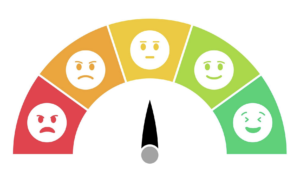 Examples Of Likert Questionnaire Scale Questions & How To Use Them Effectively